
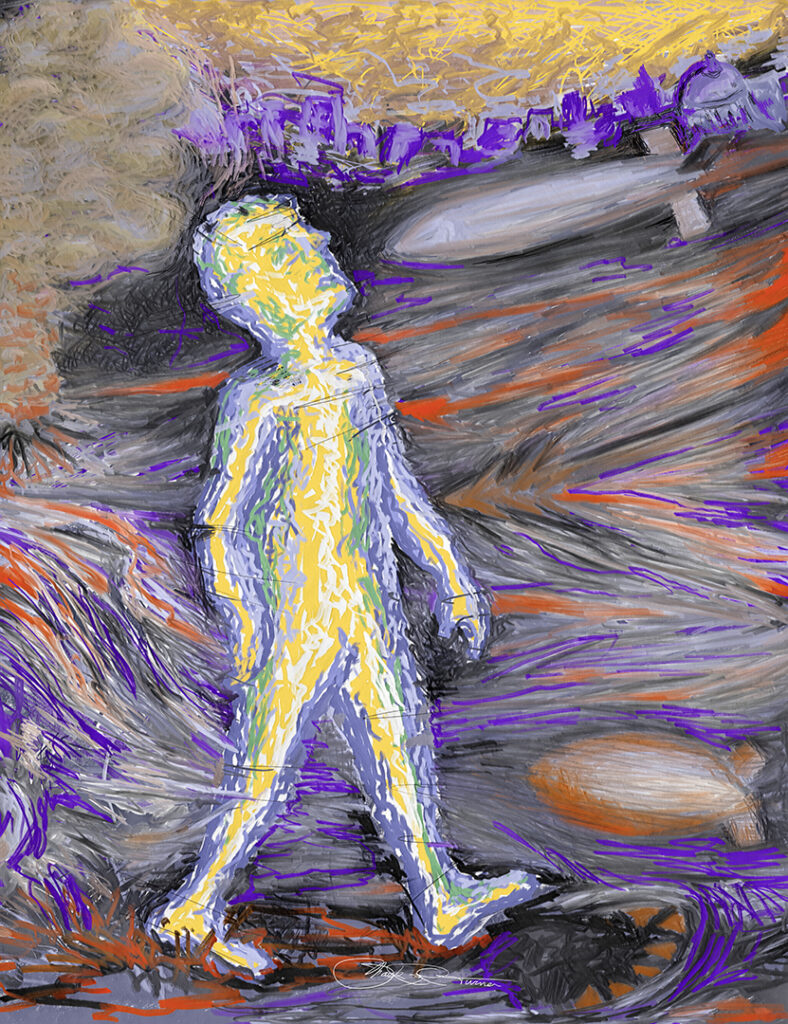
Human beings are by nature adaptors. Whatever circumstance occurs we automatically assess and choose how to navigate life in relationship to it. Many details will change during the course of time, and we will morph to cope, but we have the impulse to maintain belief that we carry the Good within. We may keep it secret but will express it when inspired to act upon our circumstances. Others dominating us will repress it but even if we seem to acquiesce and forget it, the True Self remains.
We will adapt to repression, but we can still choose to believe in and nurture our True Selves which are irrepressible. There are a variety of ways to be and express our alternatives to circumstances, and these alternatives contribute to changing the circumstances. In time, incrementally, this proves that no repressive circumstance is absolute. That’s what resurrection is about.
This self-awareness can expand beyond material practicalities to include “spirituality.” The inner self has long been called the spirit within each of us, and this cannot be usurped by anyone else. But we can deform it from its original goodness by deluding ourselves to accommodate dominant evil. This has been called “Joining the Dark Side,” or “Selling your soul to the devil.” But that does not have to be a permanent condition.
Choosing What to Internalize
Brian McLaren describes his personal liberation from being a news junkie when he would get a kind of high by learning about the latest ugliness being perpetrated and would feel smug about “us and them” righteousness. He writes about renewing his personal, inner sovereignty:
The internal realities we construct in our minds actually exist in our minds, ugly or beautiful, false or true. They shape our internal values which influence our external behavior. We tend to make the world around us resemble the world within us. Based on our focus, ugliness is everywhere or beauty abounds.
Alexis Wright is an Aboriginal writer from Australia. As an indigenous person, she understands that the end of the world has been happening for centuries for indigenous people. She understands that both colonizers and colonized need to be liberated from the mindset of colonization. The first step toward freedom, she says, is to decolonize or de-capitalize the mind, so you can “develop strengths that will not be defined by how others believe you should think.” She calls this liberation “sovereignty of mind” [1] ….
The journey to sovereignty of mind requires an inward migration, where we in a sense become refugees from our external nation, culture, economy, and civilization, even though we still live within its borders. [2]
This gives new insight into Jesus’ teaching, “The kingdom of God is within you.” (Luke 17:21) But he did not mean it as one’s personal viewpoint in which we adopt a fantasy and ignore circumstances in the material world. Just as those choosing ugliness in their hearts have manifested ugliness in the world, our inner commitment to goodness is authenticated by building concrete goodness in materiality.
Living in the System
Most of us are conditioned by our positions in society’s hierarchy to believe our loyalties are locked into our masters’ goals, usually serving whatever they are hoarding. We can change these loyalties by discerning and heeding impulses of our original inner person, often awakened by others’ good actions. Too often the awakening is the result of a personal disaster that gives us time to contemplate what really matters. As we take steps in resuming life we can honor the awakening of these yearnings in our hearts.
As we are able, we can snatch time to pause and contemplate these yearnings, using skills of creation to help us express into concrete reality the creative thoughts which engage the circumstances: writing, music, crafts, theater, dance, research, caregiving, entrepreneurialism. By many kinds of expression, we choose to thrive despite oppression; we choose the expansive view that Truth and Love are indestructible, and that circumstances are passing. Indeed, we make circumstances our raw materials and transform them into elements of a better world. Creation continues. Our constant is to keep growing and learning.
Wisdom in Choosing
This is better than our angry impulse to physically fight and make chaos, especially against physically stronger opponents. We do not throw our bodies against circumstances in an attempt for instant change. Nor do we adopt fantasies which deny circumstances. We heed the wisdom guiding around threats that would end us prematurely.
Wisdom recommends non-violent confidence that our alternative actions are contributing to the greater good of long-term reality. Because we know the good in our True Selves, we have the peace of knowing we are already free. We develop awareness of the resiliency and eternal nature of life, giving rise to the vision of circumstances changing even after our personal walk on earth.
What is the constant which nurtures life?
It is not depression and defeat of fatalism, nor is it revengeful payback. By regularly nurturing our inner persons we lift up our heads affirming redemption, and resilience that outlives the circumstances. We know who we are and we lift the heads of others by our alternative actions. As more heads are lifted expressing the Truth, Love and creation power of our True Selves, we change the world for the Good.
In the ancient world St. Paul called this “Christ in you, the hope of glory.” (Colossians 1:27)